
Comparison of hydraulic and electric injection molding machines
The choice between a hydraulic and a fully electric injection molding machine has a major impact on energy efficiency, operating costs and the long-term reliability of production. Let us look at the basic operating principles of both technologies and their key characteristics.
How a hydraulic machine works
Concept
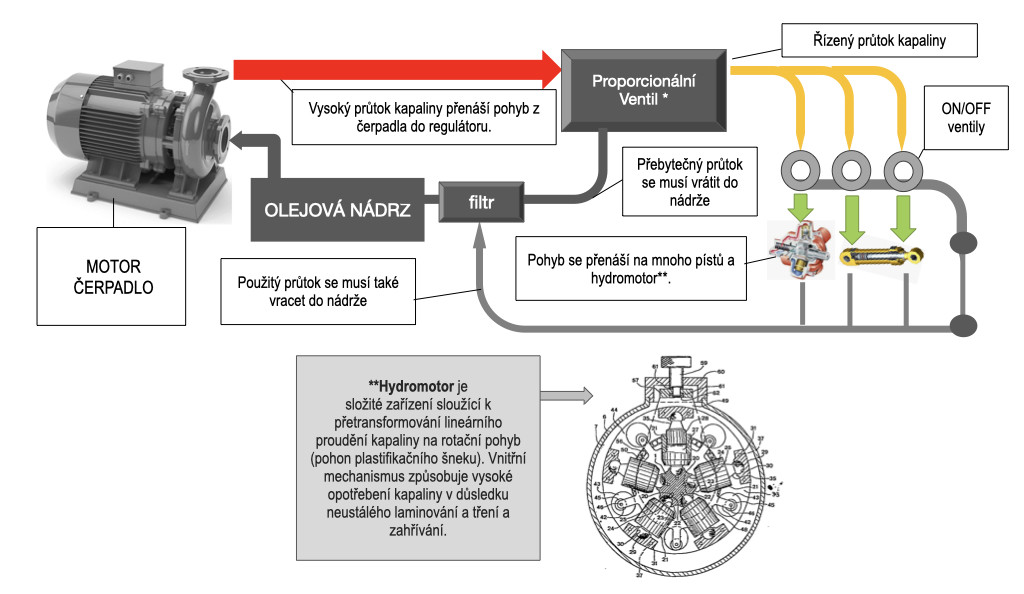
In every hydraulic machine, a pump is driven by an electric motor or servomotor. The pump creates a flow of fluid, which is then used to generate movement elsewhere in the system — through tie rods, pistons or hydraulic motors.
Oil is the medium that transfers movement from the place where it is generated to the place where it is used.
Technical limitations and operating characteristics
Pumps are designed to operate at an optimal working point at a specific speed — the so-called best efficiency point, or BEP. Outside this range, their efficiency decreases. Even when using a frequency inverter or servomotor, deviations from the optimum speed reduce the efficiency of the motor–pump system.
The fluid flow determines the available energy. Excess flow must be returned to the tank through distributors and valves, which leads to heating and gradual degradation of the fluid. Hydraulic oil therefore has to be cooled, filtered and regularly topped up.
Heat generated by friction does not contribute to the transfer of movement, but represents an energy loss resulting from the laws of physics. The use of servomotors can reduce energy losses, but friction remains a natural part of the hydraulic circuit. This also involves regular costs for replacing filters, seals, packing and operating fluid.
Advanced hydraulic systems can be equipped with accumulators, precise servo valves or modular pumps, which increase performance and partially improve efficiency. At the same time, however, they also increase system complexity as well as total investment and service costs.
How an electric machine works — and why the future is electric
Concept
In an electric machine, each movement is driven by a separate servomotor with independent control. Energy is used efficiently because precisely defined force and speed are generated at the exact place and time they are needed — without the need to return any medium to a tank.
The use of a pulley system makes it possible to reduce motor speed while also creating a protective, damping element between the motor and the point where force is transmitted. This increases reliability and extends the service life of the system.
Highly precise ball screws convert the rotary motion of the motor into linear movement or pressure exactly when required.
Technical limitations
Electric injection molding machines also have their design limits. Ball screws are currently available only in limited sizes, which means that very large machines for producing exceptionally large or heavy parts often combine electric screw drive with a hydraulic solution for linear movement.
However, with the development of larger and more reliable drives, fully electric solutions are expected to gradually expand into the large-machine segment as well. The larger the machine, the more significant the benefits of higher energy efficiency and reduced operating costs become.
Investment vs. operating costs
The higher purchase price of an electric injection molding machine is sometimes seen as a disadvantage. In reality, however, lower operating costs — especially energy savings, minimal maintenance and the absence of hydraulic oil — enable a faster return on investment.
Summary
Hydraulic machines are a proven and robust solution capable of delivering high forces. Electric machines offer higher energy efficiency, more precise control and lower long-term operating costs.
The choice between the two technologies depends on the type of production, part size and the company’s economic priorities. However, the trend towards higher efficiency and cost savings clearly strengthens the role of fully electric solutions in modern plastic injection molding.
